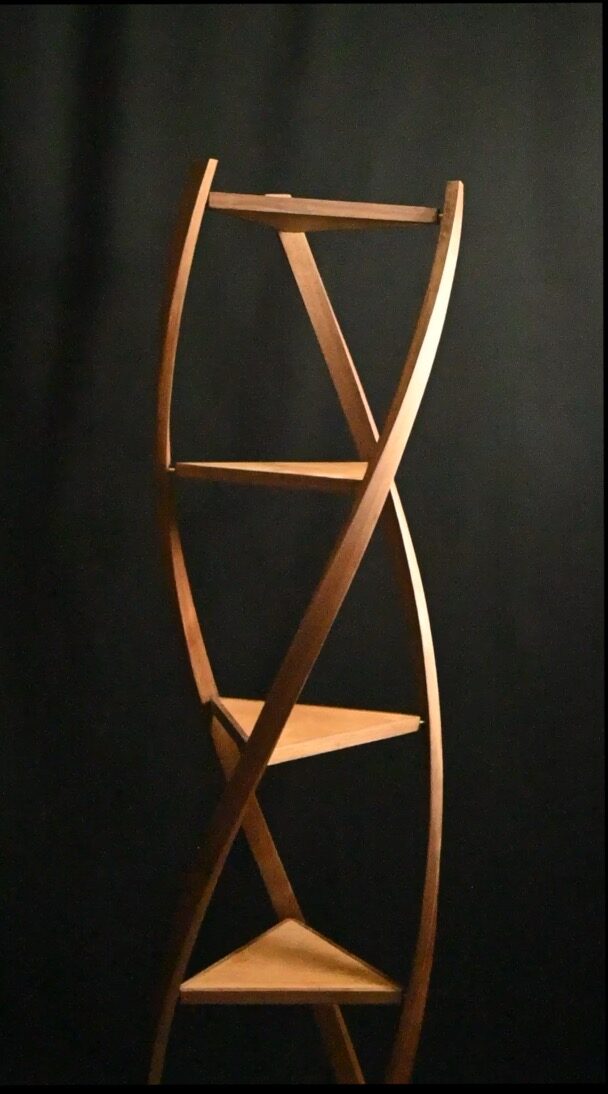
Sometimes you just gotta try it and see. I had this idea floating around for a while. It was based on the shape of a helix. The helix familiar to most is a strand of DNA and I had the idea to use that shape to create a display stand.
The only problem with the iconic shape of DNA is that it is a double helix, which would mean my structure would have only two uprights that twist around. Two legs aren’t generally stable. Ladders, for example, are a sort of straightened helix but they need something to lean on otherwise they fall over. It’s amazing evolution has managed to create bipedal creatures that work so well. But I guess it took evolution some time, trial and error to figure it out and I can’t work in evolutionary timescales. So I took that kernel of an idea and took a huge evolutionary shortcut and added an extra upright – a triple helix. I figured this would give me the stability I needed. Three legged stools, for example, are very stable and don’t wobble like their four legged brethren or fall over like a two legged stool would. It’s odd that evolution didn’t seem to think three legs were a good idea when they work so well for stools! I digress – back to the build.
So how to make this triple helix a reality. I needed each upright to be a perfectly identical spiral for the design to work. I could write a small essay on the exact process, pain and learnings I went through on this part of the build but the highlights are as follows:
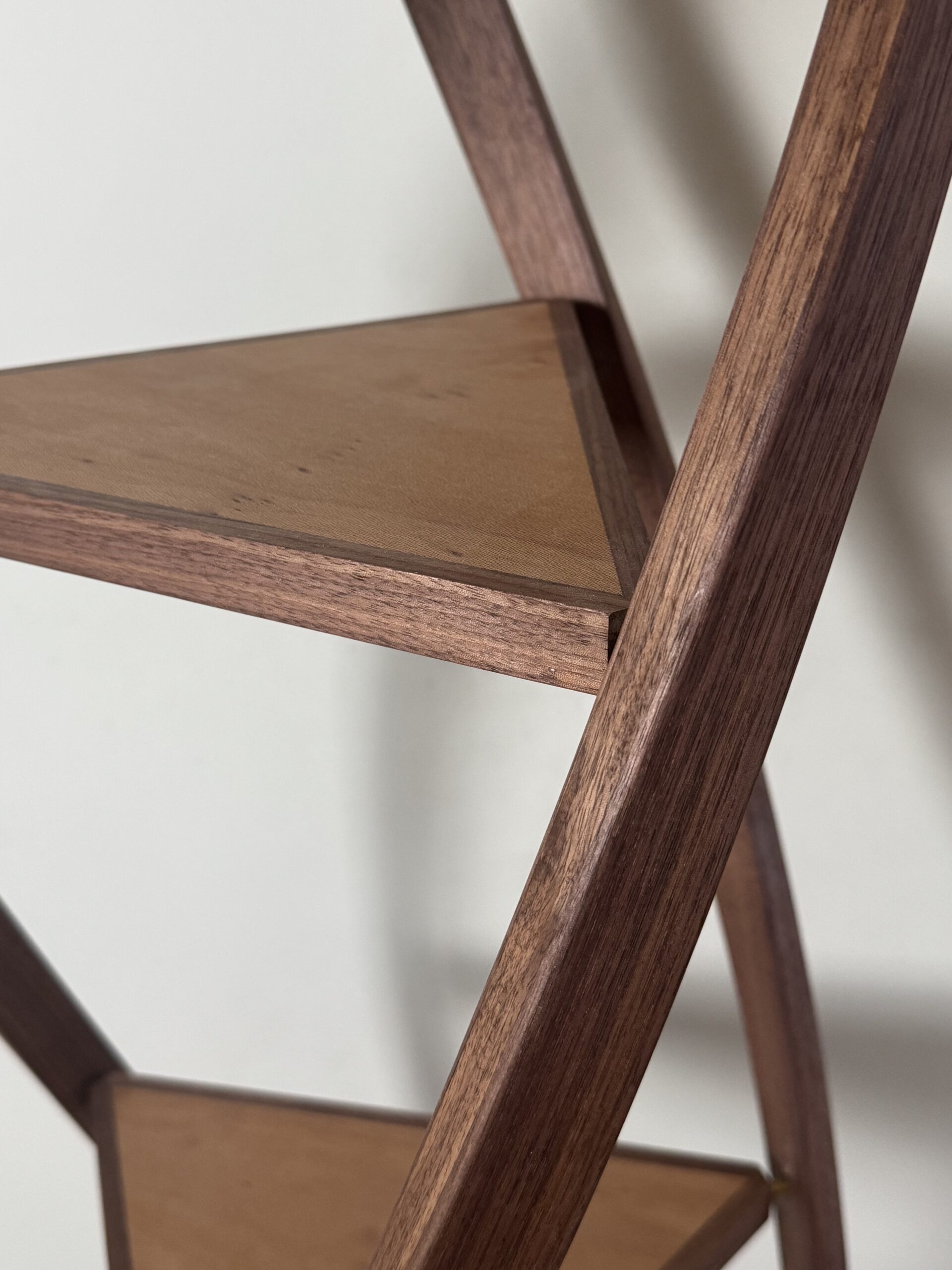
With three legs created (that sounds so easy when written down) my next choice was the shape of each shelf. Round shelves would work with the design but I decided to lean into the three theme even more and create triangular shelves to span the three uprights. This was an interesting little design choice too. I didn’t want a distinct grain on each shelf. I felt that unless the grain was somehow lined up perfectly on each shelf then it would look a little odd if the grain on each shelf ran in different directions. So I wanted something that had very little grain at all so to avoid any visual jarring. A veneer burl of some kind could work but I’d need quite a bit for all the shelves and it’s not exactly cheap, particularly in walnut. Instead I opted to use London Plane, which has very little prominent grain. In fact it has some amazing figure but I wasn’t going to use it for that characteristic.
Another thing to consider was that if I just used the wood as a solid piece then you would end up seeing engrain and all sorts of weird effects on certain sides of each triangle. To counteract this anomaly I decided to unify each shelf by edging each side in long grain. This created a consistent grain wrap all the way around each triangle. Oh yeah – sigh – that introduced a problem of wood movement. I can’t wrap solid wood without the risk that wood expansion might open up a corner of the triangle. So to counteract that each shelf is actually a core of stable MDF, veneered in London Plane and then wrapped in long grain Walnut on the edges. Quite a lot of steps but the end result is triangular shelves that look consistent from any angle. I’ll spare you with the custom clamp I also needed to build to glue the edging on a triangle shaped object. Success.
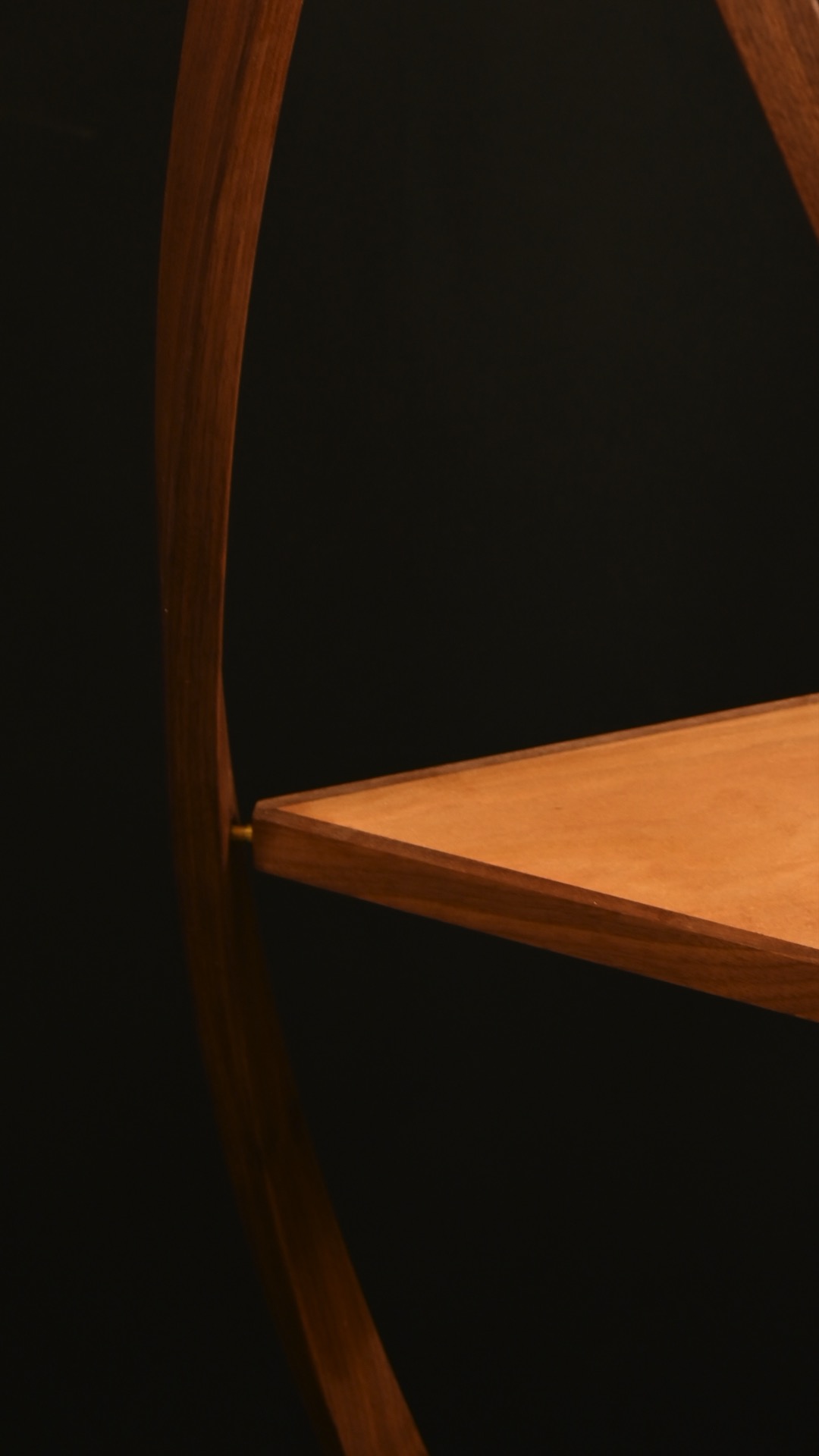
The final design choice was how to join the shelves to each upright. I went for brass rod to join it all together, so that the shelves sort of float in between the uprights. I felt at the time this might be a more practical way to join the shelves onto the curved surface of the upright (Future me laughed at this naivety…).
Without reliving the struggles to make this helix idea a reality I am actually – kinda – pleased with the result. I think I would need to take another swing at it to resolve some of the construction challenges. The main one being the shelves are not perfectly on the the same horizontal plane. They are close but not quite close enough to be truly triumphant. The spirals were the biggest challenge initially but I can actually now create those in a very consistent way. The joinery of the shelves is the last piece of the puzzle but that will need to be for another day. I’ve learnt all I can from this particular version. Would anyone want to buy one? Who knows. But sometimes just making something complex is worth it for the things you learn along the way.
And a design element I didn’t really explore is how the feet and tops of the uprights finish. They are currently just cut square with the ground. Perhaps they need a more organic flourish somehow.
New stuff is hard.